 If you recently bought an electric vehicle — or are planning to — one of your first questions is probably the EV charger installation cost for your home. You've likely searched "how much does it cost to charge an electric car" or "electric car charger installation near me" and found prices that range from $800 to $6,000. That spread is confusing, and it's real. Your final cost for installing a charging station for electric cars depends almost entirely on the condition of your home's electrical system and where you need the charger located.
This guide breaks down every cost component of a home EV charging station — from the charger unit itself to electrical panel upgrades, trenching, permits, and labor — so you know exactly what you're paying for and why. All figures are verified and current as of 2026.
The Short Answer: What Does Level 2 EV Charger Installation Cost?
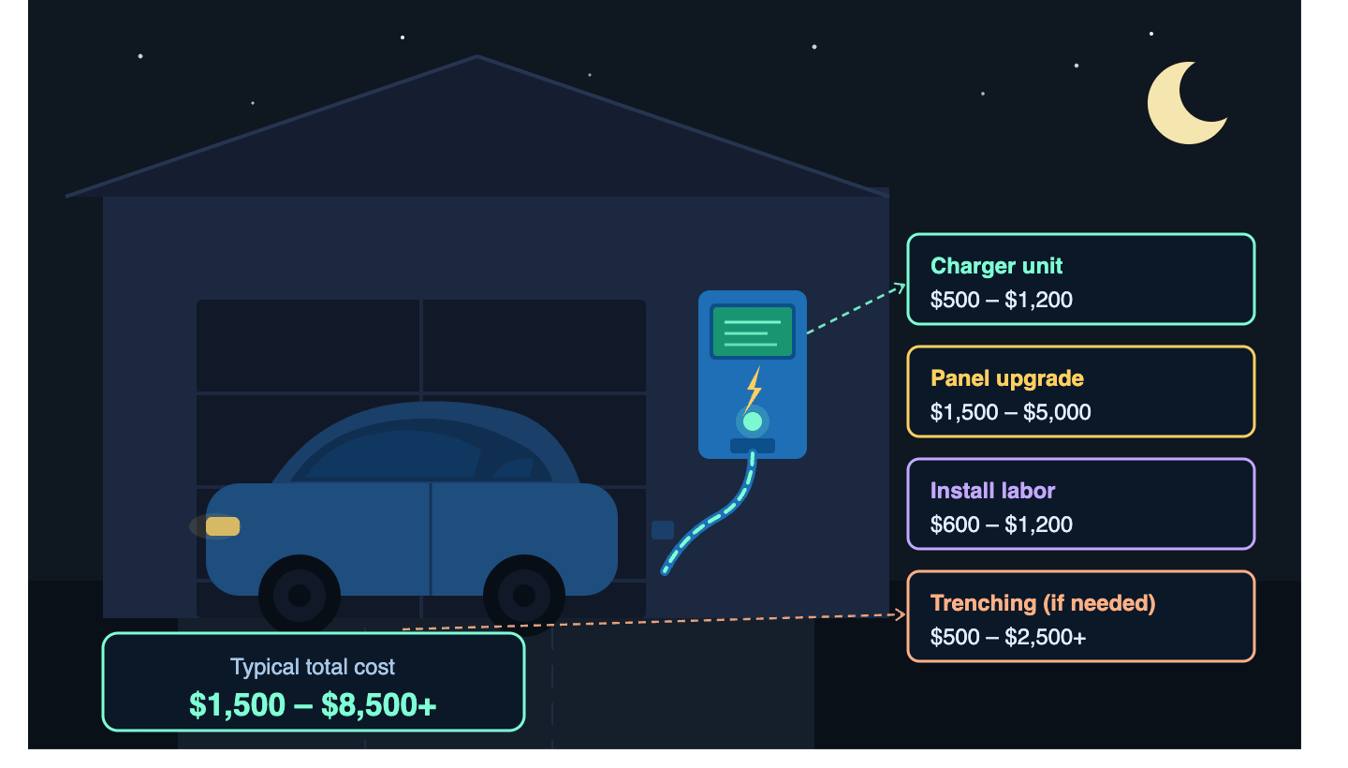
Most homeowners pay roughly $1,500 to $3,500 for a professionally installed Level 2 home EV charger in 2026, before incentives. Simple installs with a modern panel and short wire run land between $1,500 and $2,000. Complex jobs that need a panel upgrade, long wiring runs, or trenching can climb to $5,000 or more. In the Northeast — where labor rates and permit costs run 15 to 25% above the national average — always budget toward the higher end of every range.
Here is a quick reference breakdown:
Component | Estimated Cost |
|---|---|
Level 2 charger unit (ChargePoint Home Flex, Tesla Wall Connector, Rivian Wall Charger, etc.) | $500 – $1,200 |
NEMA 14-50 outlet installation (simple, near panel) | $500 – $900 |
Hardwired Level 2 charger installation (labor only) | $600 – $1,200 |
Outdoor / exterior installation adder | $400 – $1,200 additional |
Underground trenching | $500 – $2,500+ additional |
Electrical panel upgrade (if required) | $1,500 – $5,000 |
Smart electrical panel installation | $2,500 – $5,500 |
Sub-panel addition (detached garage) | $800 – $1,800 |
Permit fees | $75 – $300 |
Electrician labor rate | $100 – $175 per hour |
What Is a Level 2 EV Charger?
A Level 2 EV charger uses a dedicated 240V circuit to deliver significantly faster home EV charging than a standard wall outlet. While a Level 1 charger adds just 3 to 5 miles of range per hour using a 120V outlet, a Level 2 charging station delivers 20 to 50 miles of range per hour depending on your vehicle and charger amperage — enough to fully charge most EVs overnight from a home charging station.
For most homeowners, a Level 2 EV charger installation means one of two setups:
A NEMA 14-50 outlet — a 240V, 50-amp receptacle that a portable Level 2 EVSE plugs into, similar to how a dryer plugs into the wall. The NEMA 14-50 is the most common 14-50 outlet for Level 2 EV charging at home, delivering up to 9.6kW (40A at 240V) and providing approximately 20 to 30 miles of range per hour of charging.
A hardwired Level 2 charger — a unit like the Tesla Wall Connector, ChargePoint Home Flex, or Rivian Wall Charger that is permanently wired directly into your electrical panel for maximum amperage and a cleaner installation. A hardwired EVSE home setup is the preferred choice for daily EV drivers who want the fastest and most reliable electric vehicle charging at home.
For context, Level 3 charging stations are commercial-grade infrastructure that operates at 480V or higher and is not designed or permitted for residential installation. A hardwired Level 2 charging station is the highest-performance home EV charging solution available and the industry standard for home electrification.
Cost Factor 1: The Charger Unit Itself
The most popular Level 2 charger brands typically range from $500 to $1,200 depending on brand, features, and power output. Budget-friendly models in the $500 to $700 range focus on reliable charging at 40 amps with minimal extra features. Premium smart chargers in the $700 to $1,000 range offer app-based charging scheduling, energy usage monitoring, and integration with home automation systems. Units with extended cables, bidirectional capability, or advanced load management can reach $1,200 or more.
Popular EV home charger options for 2026:
Tesla Wall Connector — natively uses the North American Charging Standard (NACS) connector now adopted by Ford, GM, Rivian, and most major manufacturers. Ships with a 24-foot cable and supports load balancing across multiple units. Currently priced around $420 to $500. Tesla charger installation requires a licensed electrician and a dedicated 240V circuit.
ChargePoint Home Flex — a flexible amperage EVSE home charger that works with both a NEMA 14-50 outlet and a hardwired connection, delivering up to 50 amps and approximately 37 miles of range per hour. Currently priced around $540 to $700.
Rivian Wall Charger — purpose-built for Rivian vehicles but J1772 compatible for use with any EV. A popular choice for Rivian owners looking for a permanent home charging station.
Emporia Pro — a popular smart EVSE with energy monitoring and load management features
J1772 charger units — the universal EV charging standard compatible with all non-Tesla EVs and Tesla vehicles with a J1772 adapter. Most hardwired Level 2 chargers ship as J1772 chargers by default.
NACS charger units — increasingly common as NACS adoption accelerates across automakers in 2026
Whether your vehicle uses a J1772 connector, a NACS port, or requires a Tesla Wall Connector, Charge the Coast can match you with a licensed EV installer who accommodates your specific vehicle's charging requirements. You can also use a service like Qmerit to find certified installers, though Charge the Coast's concierge model includes rebate paperwork and permit coordination that most national installer networks do not provide.
Cost Factor 2: NEMA 14-50 Outlet vs. Hardwired Installation
One of the first decisions you'll make in your EV charging installation is whether to install a NEMA 14-50 outlet for a plug-in EVSE or go straight to a hardwired Level 2 charger. The cost difference matters.
A straightforward NEMA 14-50 outlet installation — also written as NEMA 14 50 outlet — in a garage near the panel in the Philadelphia and South Jersey market typically costs $500 to $900, covering labor, a dedicated 50-amp double-pole breaker, 6-gauge copper wiring, the 14-50 outlet receptacle, and permit fees. Longer runs, finished walls, or panel upgrades push costs to $1,200 or more.
A hardwired Level 2 charger installation typically costs $600 to $1,200 for the electrical work alone in our service area, not including the charger unit. Hardwired chargers connect directly into your electrical system and are often preferred for higher-amperage electric vehicle charger installation and long-term daily use, as they avoid wear on a receptacle and reduce the chance of loose connections over time. They also simplify weatherproofing for outdoor EVSE home installations.
The plug-in EVSE approach using a NEMA 14-50 outlet is worth considering if:
You want flexibility to take your charger with you when you move
You plan to upgrade your charger unit in the future without rewiring
Your vehicle does not require more than 40 amps
The hardwired approach is better if:
You want the cleanest, most permanent home charging station setup
You are installing a Tesla Wall Connector or ChargePoint Home Flex at maximum amperage
You are in a high-humidity or outdoor environment where a receptacle could corrode
Cost Factor 3: Distance From Your Electrical Panel and Trenching
Home layout drives labor hours, and labor hours drive EV charger installation cost. The biggest swings in Level 2 EV charger installation cost often come from physical access and routing, not from the charger brand. Distance from the panel is the leading cost factor for any EV charging station installation. A short run with easy access usually costs far less than a long run through finished ceilings, exterior walls, or complex pathways. A detached garage often requires exterior conduit or trenching. Driveway-side parking can require longer protected runs.
Here is how distance and routing affect your EV installation cost:
Run Distance / Scenario | Estimated Added Cost |
|---|---|
Panel in garage, charger nearby (under 20 ft) | $100 – $200 additional |
Run through unfinished basement (20–50 ft) | $200 – $500 additional |
Run through finished walls or ceilings | $500 – $900 additional |
Detached garage requiring exterior conduit | $600 – $1,200 additional |
Driveway installation requiring underground trenching | $500 – $2,500+ additional |
A note on trenching specifically: Trenching is required when wiring needs to run underground — most commonly for detached garages, driveway parking pads, or outdoor EV home charger installations that cannot be reached by surface conduit. Typical trenching costs range between $300 and $2,000 or more depending on the length of the run and the type of surface being cut through. For a more precise breakdown, trenching costs $15 to $25 per linear foot, meaning a 60-foot trench adds $900 to $1,500 to your EV charging installation project before the wire cost is even factored in. In the Philadelphia and South Jersey area, where labor rates run higher than the national average and many properties have concrete driveways or paved rear yards, expect trenching to land at the higher end of that range. If the trench cuts through a concrete driveway or paved surface, add $500 to $1,000 for surface cutting and restoration.
A detached garage installation also typically requires a sub-panel in the garage costing $800 to $1,800 to distribute power locally, in addition to the trenching cost.
For Philadelphia-area homeowners with older rowhomes, the panel is often located in the basement while the desired home EV charging station location is a rear driveway or street-facing parking pad — a run that can easily add $500 to $900 to the total project cost even without full trenching. Homeowners with detached garages or rear lot parking should budget accordingly and always request an in-person site assessment before accepting any quote for a plug-in EV charging solution.
Cost Factor 4: Electrical Panel Upgrade
This is the biggest wildcard in your EV charger installation cost. A Level 2 charger requires its own dedicated 40 to 60 amp circuit. If you have a 200-amp electrical panel with open breaker slots, you are usually in great shape and the job stays simple. But if you have an older 100-amp or 125-amp panel, or if your panel has reached capacity, you will likely need an electrical panel upgrade to safely support an EV charger.
The DOE's National Renewable Energy Laboratory residential EVSE cost study found the median installed cost for a Level 2 home EV charger was $1,096 for homes requiring no panel work. Homes requiring electrical panel upgrades saw median costs jump to $2,744. In the Northeast those medians run noticeably higher.
Typical electrical panel upgrade costs in our service area:
Upgrade Type | Estimated Cost |
|---|---|
100-amp to 200-amp service upgrade | $1,500 – $5,000 |
Smart electrical panel installation | $2,500 – $5,500 |
Sub-panel addition (avoids full upgrade) | $800 – $1,800 |
Load sharing device (avoids upgrade entirely) | $250 – $600 |
The cost to replace electrical panel systems varies based on current panel amperage, age of wiring, utility involvement, and panel location. For many older Philadelphia-area homes the electrical panel replacement cost lands toward the higher end of that range due to older service infrastructure and higher local labor rates. If you are searching for an electrician for electrical panel replacement in the Philadelphia or South Jersey area, our vetted network handles both the electric panel upgrade and the Level 2 EV charger installation in a single coordinated visit — saving you the cost of two separate service calls.
One money-saving option worth asking your electrician about: a load sharing device can safely manage your electrical load, save thousands of dollars compared to a full panel upgrade, and use surplus panel capacity to safely charge your EV. Expect to pay $250 to $600 for a quality load management device in 2026.
Cost Factor 5: Indoor vs. Outdoor Installation
Outdoor EVSE home installations require weatherproof conduit, exterior-rated boxes, GFCI protection, and additional sealing to keep moisture out. If wiring has to run along the outside of your home or underground, that adds time and materials. In our service area expect to pay $400 to $1,200 more for outdoor setups compared to a straightforward indoor installation.
For Philadelphia-area homeowners without attached garages — common in rowhouse neighborhoods across the city and inner suburbs — an exterior weatherproof NEMA 14-50 outlet or hardwired EVSE home charger enclosure is the standard plug-in EV charging solution. Our network electricians are experienced with the permitting and weatherproofing requirements for exterior electric vehicle charger installation in both Pennsylvania and New Jersey.
Cost Factor 6: Permit Fees
Most jurisdictions require an electrical permit for Level 2 EVSE installation. Permits are typically pulled by your licensed EV installer and cost $75 to $300 in our service area. Some municipalities require a final inspection by the building department, which may be included in the permit fee or billed separately.
Local permit costs in our service area:
Jurisdiction | Typical Permit Fee |
|---|---|
$100 – $200 | |
Montgomery County municipalities | $75 – $150 |
Bucks County municipalities | $75 – $150 |
Delaware County municipalities | $75 – $150 |
Burlington County NJ municipalities | $100 – $200 |
Mercer County NJ municipalities | $100 – $200 |
Never skip the permit. If you don't get a permit, you could face fines, your homeowner's insurance might not cover damages from an unpermitted EV charging installation, and you could have trouble selling your home later. Charge the Coast's network electricians handle all permit filing and inspection coordination on your behalf.
Cost Factor 7: Smart Charger vs. Basic Charger
The $150 to $300 premium between a basic Level 2 charger and a smart electrical panel-integrated charger with scheduling pays for itself quickly for households enrolled in time-of-use electricity rate programs. Smart chargers like the ChargePoint Home Flex allow you to schedule electric vehicle charging at home during off-peak hours when electricity rates are lowest — a feature that reduces your long-term EV home charger operating costs significantly.
For PECO customers in Pennsylvania, enrolling in PECO's time-of-use rate program after your EV charging installation can generate meaningful ongoing savings. For PSE&G customers in New Jersey, time-of-use rates are being rolled out as the off-peak credit program phases out in 2026.
What Does a Real Installation Look Like? Three Scenarios
To make the EV charger installation cost ranges more concrete, here is how three common Philadelphia-area homeowner situations shake out:
Scenario 1 — Simple install, newer home with attached garage 200-amp panel with open slots, garage adjacent to panel, 15-foot hardwired run. ChargePoint Home Flex EVSE home charger installed. No electrical panel upgrade needed. Estimated total: $1,500 – $2,200 all-in including charger, labor, and permit.
Scenario 2 — Older rowhome, basement panel, rear driveway EV installation 100-amp panel requiring upgrade to 200-amp service. 50-foot run from basement panel through finished walls to rear exterior NEMA 14-50 outlet. Weatherproof enclosure required. Estimated total: $3,500 – $6,500 all-in.
Scenario 3 — Detached garage requiring underground trenching 200-amp panel in house, detached garage 60 feet away. Underground trench required through yard. Sub-panel needed in garage. Tesla Wall Connector hardwired. Estimated total: $4,500 – $8,500+ all-in depending on surface type and sub-panel requirements.
How Much Can Rebates Reduce My EV Charger Installation Cost?
Before you finalize your budget, factor in the electric vehicle incentives available to homeowners in our service area. The right stack of electric car rebates and EV incentives can dramatically reduce your out-of-pocket EV charger installation cost:
Incentive | Amount | Who Qualifies |
|---|---|---|
Federal 30C tax credit | Up to $1,000 | All counties — census tract eligibility required — expires June 30, 2026 |
PSE&G Make-Ready rebate | Up to $1,500 | Burlington County PSE&G customers |
PSE&G pole-to-meter upgrade | Up to $5,000 | Burlington County PSE&G customers (if applicable) |
PA DEP AFV vehicle rebate | Up to $4,000 | PA residents — income eligibility required |
PECO EV driver rebate | $50 | PECO residential customers |
For a complete breakdown of every electric car incentive available in Philadelphia, Montgomery, Bucks, Delaware, Burlington, and Mercer Counties, visit our full rebates guide on the Charge the Coast website.
What Does a Home EV Charger Installation Add to Your Home's Value?
A pre-installed Level 2 charging station with a dedicated 240V circuit represents real infrastructure value that EV-owning buyers specifically look for. The circuit and panel capacity are the more valuable components — the EV home charger unit can be upgraded, but the electrical infrastructure cannot be easily replicated. As home electrification accelerates across the Philadelphia region — with more households adding EV chargers, heat pumps, and bidirectional charging capability — homes with existing Level 2 EV charging infrastructure are increasingly listed as a selling feature in high-EV-adoption markets like the Philadelphia suburbs and South Jersey.
FAQs: EV Charger Installation Cost
Q: How long does a Level 2 EV charger installation take?
A: Simple EV installs near the panel are typically completed in a few hours once permits are cleared. Complex projects involving electrical panel upgrades, outdoor trenching, or long conduit runs may require multiple visits and can take a full day or more. Factor in 1 to 2 weeks for permit approval and inspection scheduling. Most standard EV charging installations in our service area are completed within 2 to 4 weeks from first contact to final inspection.
Q: Do I need an electrical panel upgrade for a Level 2 EV charger?
A: Not always. If your home has a 200-amp panel with available breaker slots, an electrical panel upgrade is typically not required. The biggest risk factors are limited breaker space, older electrical equipment, and service capacity that leaves little room for a new 240V charging circuit. Our electricians perform a comprehensive load calculation before any work begins so you know upfront whether an electric panel upgrade is needed — or whether a load management device could save you the cost of a full panel replacement.
Q: Does my EV installation require trenching?
A: Only if your home charging station location cannot be reached by surface conduit — typically detached garages, driveway parking pads, or rear-lot parking situations common in Philadelphia rowhome neighborhoods. Trenching costs $15 to $25 per linear foot before wire costs, and cutting through concrete or paved surfaces adds $500 to $1,000 for surface restoration. Always request an in-person site assessment before accepting a quote for any EV charging installation that involves a detached structure or significant distance from your panel.
Q: Can I install a Level 2 EV charger myself?
A: No. A 240V EV circuit requires licensed electrical work for code compliance, safety, and insurance validity. DIY electrical work on 240V circuits also voids most EV home charger warranties, disqualifies you from electric vehicle incentives and rebates that require licensed installation, and can create serious liability problems when selling your home. Always use a licensed EV installer.
Q: Is a hardwired or NEMA 14-50 plug-in installation cheaper?
A: It depends on the charger model, outlet requirements, and local code. Plug-in NEMA 14-50 setups — also written as NEMA 14 50 outlet — are generally slightly less expensive upfront and offer more flexibility if you plan to upgrade equipment later. Hardwired installations are often preferred for higher-amperage EV charging at home, cleaner aesthetics, and outdoor durability. Our team advises on the best plug-in EV charging solution for your home's specific layout during your free consultation.
Q: What is the difference between Level 1, Level 2, and Level 3 charging?
A: Level 1 uses a standard 120V outlet for slow trickle charging adding 3 to 5 miles of range per hour — no installation needed but impractical for daily EV use. Level 2 uses a dedicated 240V circuit for fast home EV charging adding 20 to 50 miles of range per hour — the industry standard for residential electric vehicle charger installation. Level 3 charging stations operate at 480V or higher and are commercial-grade infrastructure not available for residential installation. For home use, a Level 2 charging station is the gold standard.
Q: Will my electricity bill increase significantly after installing a Level 2 EV charger?
A: It may be less than you might expect, and is a net positive when factoring in all the money you will be saving on gas. Charging an average EV driving 13,500 miles per year adds approximately $50 to $80 per month at current electricity rates in Pennsylvania and New Jersey. This compares favorably to the $150 to $250 per month most drivers spend on gasoline. Enrolling in a time-of-use rate plan and scheduling your EV home charger to run overnight further reduces this cost.
Q: Does the EV charger installation quote include the charger itself?
A: Not always. Some electricians quote labor and permit scope only, expecting you to supply the EVSE home charger unit separately. Others provide all-in quotes including hardware. Always confirm whether the bid includes the charger unit, mounting hardware, permit fees, and inspection before comparing quotes — two EV charger installation quotes that look similar on paper may cover very different scopes of work.
Get a Free Quote From a Vetted EV Installer Near Me
Charge the Coast connects homeowners in Philadelphia, Montgomery, Bucks, Delaware, Burlington, and Mercer Counties with licensed EV installers who specialize in Level 2 EV charger installation. Whether you need a NEMA 14-50 outlet, a hardwired home EV charging station, a Tesla Wall Connector, a Rivian Wall Charger, or a J1772 charger, we handle permits, rebate paperwork, and the entire EV charging installation process from consultation to completion — so you get the best plug-in EV charging solution for your home at the lowest possible out-of-pocket cost.
Get your free quote at chargethecoast.com/start-charging
All cost figures are verified as of 2026 and represent estimated ranges for the Philadelphia and South Jersey service area. Costs in the Northeast typically run 15 to 25% above national averages. Your actual cost will depend on your home's specific electrical setup. Always obtain multiple quotes from licensed electricians before committing to a project.
Charge the Coast is a professional referral network; all physical installations are performed by independent, licensed, and insured electrical contractors.